The Traditionalist View-By C. M. Kotlan
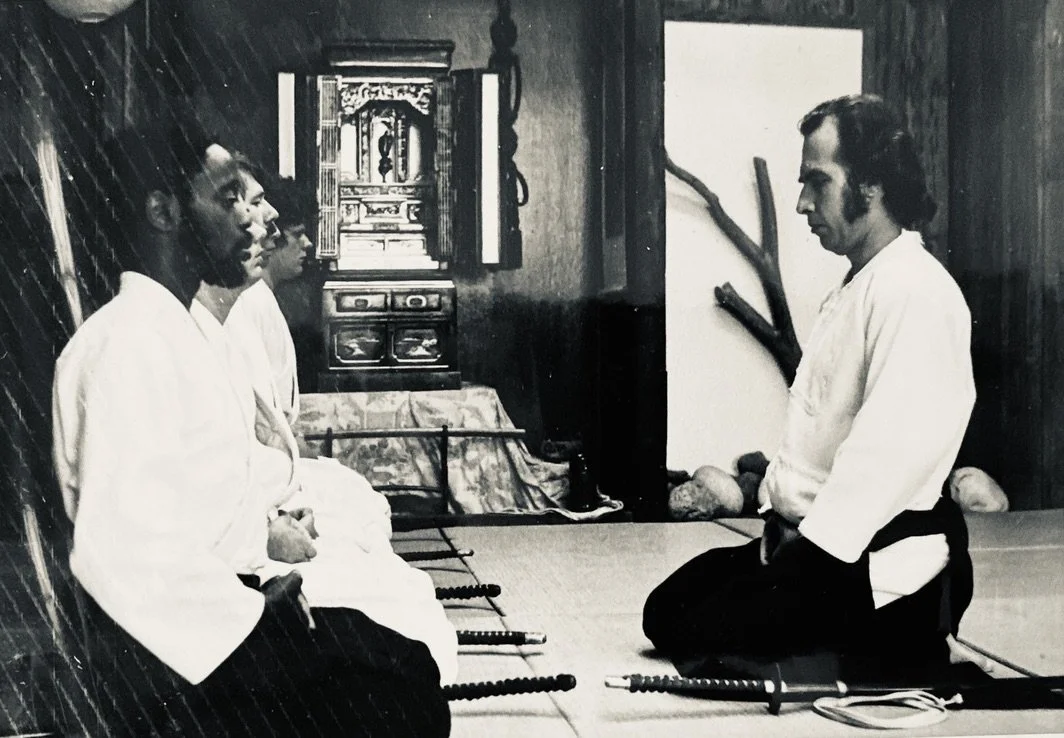
Kneeling on the mat in front of the tokanoma, the shrine enclosure in his 20 mat dojo, the instructor seemed to fill the room with his presence. He was wearing white judo gi and black hakama. The butsudan (a Buddhist sanctum) was open behind him, the gold altar doors glistening dully like wet butterfly wings. Inside the altar, the ancient carved wood figure was as still and relaxed as the instructor.
This is a traditional dojo. It is dominated by the "presence" of the instructor--by his ki. The effect is subtle and powerful.
"Sensei doesn't like me," one of the students on the mat at the time said afterward.
The student was told this wasn't true.
"He must dislike me for some reason," the student insisted. "Did you see the way he looked at me?"
In point of fact, everyone on the mat had seen or felt the scowl, and it made all of the students uneasy.
Lovret leaches aikijutsu and kenjutsu. Kenjutsu, the study of sword, is the most traditional in terms of continuity and time. Many of the techniques and forms have been taught unchanged for almost a thousand years. Aikijutsu traces its roots back to aikijujutsu developed in the 13th century. It was updated and changed in the late 19th century by Sogaku Takeda and continued under the name of Daitokan.
From Daitokan, Uyeshiba invented aikido in the 1920's.
In a sense, Lovret has a handhold on the best of two worlds. Every year his dojo hosts Yonezawa Sensei from the Daitokan School in Japan. Yet his connections with aikido are such that he has the advantage of a "new" school.
Yet, new or old, aiki, aikido, or aikijutsu Lovret says are taught with the traditional spirit and appreciation of ki, giri (duty) and respect. Lovret is a staunch traditionalist, no matter how the age of his art is figured. To him, there are dojo (traditional) and studios (non-traditional). Studios Lovret says, "Stress wall-lo-wall carpets, saunas, showers. dressing rooms and pleasant surroundings..." He didn't say anything bad about them, but the wave of his hand was disdainful as he indicated the bare mats and butsundan of his own dojo. "My dojo has a mat and a shrine."
Inside the San Diego dojo, the effect is one of peace and tranquility. the outside world, the beach community of Ocean Beach in southern California, disappears when one enters Lovret's budokai. The visitor feels transponed from the 20" century.
Lovret favors rigid training techniques and expels students for poor attendance. There are always students who want to know a little of karate or judo or whatever. "I leave that to the studios,” Lovret says coldly. "It's better to penetrate to the heart of a single art than to play around the edge of many. Understanding one technique is better than knowing a thousand."
This is perhaps the most important area where the instructor separates other schools which call themselves traditional from the schools he considers traditional. Part of it is self-interest displayed by giving students what they want in order for the instructor to build a large school. He points out "When the ladies downtown give the public what they want and relax their principles, the ladies get busted by the police. There is a word for those who sell themselves for money…”
Then, according to Lovret, there are school operations who say they're not non-traditional just because they don’t require bowing or traditional gi. Lovret's attitude that such operators "are like a woman saying she is only a little pregnant" doesn't endear him to other dojo operators who call themselves traditional.
Objections bounce off his craggy face. It's not, he says, that he can't stand the "studio" operators. In fact, Lovret allows his senior students to teach at the slickly operated American Colleges of Karate in nearby El Cajon. The school there is massive, with more than 300 students. The operator admits, even brags, that he is starting an American system that borrows from all the traditional schools, whether Japanese, Chinese, Korean or army special forces. "If it works," this operator says with American pragmatism, "we use it."
Lovret says his students can teach there, provided the studio bends to the teaching. The studio must accept traditional teaching, in fact, and become traditional in respect to the teachers--or not have the teachers.
The Instructor is not bothered by the school's "new" format of "American" art. It's all right. Lovret says. "Just don't call it tae kwon do, karate, or kung fu."
He is even satisfied that there are non-traditional schools. He gets the "traditional" students, and the ones who go to the studios would not be acceptable to him anyway.
"I run a dojo," he says. "Not a kindergarten or geriatrics home. I don't have separate classes for children, women and the elderly. I throw them all in with 200 pound men and they either run home and cry or get very, very quick and very mean."
As he says it, there is no competition between his austere budokai, and the plush rugs and glittery mirrors of the American College of Karate.
Whether dealing with a beginning aikijutsu student learning how to fall or an advanced sword student, Lovret is concerned with the spirit more than the techniques. "The dojo is more important than anyone or anything--even me. The dojo has its own feeling, its own atmosphere."
When Lovret describes it, the dojo has an ambience of life of its own. It has a feeling about it that the rawest beginner can sense when he walks into the room. It is this ambience that engenders respect and the traditionalist values.
On the mats, Lovret is a surprisingly gentle man, though his students stand in awe of him. Although his discipline is rigid, he himself treats the students with the softness made necessary by their ignorance and with the respect with which the dojo is imbued. Sitting in zazen (religious meditation), his eyes focused inward, totally relaxed, Lovret explains, "the way is timeless the study of techniques is the worry about the shape of the leaves and the color of flowers when you should be studying the roots. The essence of budo is not what you do, but how you do it.”
"My duty is to continue the way by finding a worthy student as was my master's purpose and his master's before him. It is not to make money or please myself."
"The best way to understand any art is to get on the mat and sweat, bleed and hurt for several years. I found out long ago that a student will work hard if he likes me. He will work very hard if he is afraid of me. My duty is to make him work very hard."
There is an innocence in this attitude that cannot be duplicated by any studio operator.
Typical Americans react to traditional training usually with dismay and disbelief. The rules at the bodokai are simple. The student goes on the mat with a real sword--the first time--or he doesn't go on the mat at all.
There are other "traditional" Japanese schools which teach kenjutsu with imitation, unsharpened swords. This is what the potential student expects. He does not expect to be playing with a two-and-a-half-foot razor blade. If that ends a budding sword career, Lovret just shrugs. "It is the best way of training," he says. There is no question that in the silence that follows, he also means that there is no other way.
"Students don't know anything," Lovret is fond of saying. "That is why they are students and not instructors. I tell my students what they want and they tailor themselves to the dojo. The way is timeless. It is the student's responsibility to change. That is what training is for."
Some of the very traditional teachers have been accused, in the past, of brutality: Striking or beating students, even injuring them. Of this, Lovret will usually take the position that the instructor involved is admirable.
"If you want to make a sword," he explained, "you do not take a lump of iron and pet it. You heat it red hot and then pound it with a hammer. The dojo must be a furnace and the mat the hammer. You should never break a student, but occasional surface damage is good for the spiritual development."
When Lovret is on the mat with a student, sword at his side teaching the student to drive his opponent with ki, to slice him in half with a flash of steel and a hoarse shouted kiai, one of the true dichotomies of the traditionalist training surfaces. Studios and other dojo operators stress self-defense and fighting prowess. Lovret does not.
His eyebrows lift in either surprise or disbelief or disapproval or all three when a prospective student asks how long it will be before he can fight well.
“The best way to learn how to fight is to fight, not practice fighting. If you really want to learn fighting," he says, "go into the roughest bar in the roughest neighborhood. Pick out the biggest man there and spit in his beer. When you get out of the hospital, repeat this process. After a while, if you survive, whenever you enter the bar, everybody will run away. Anybody can fight. It is a natural instinct. But kata teaches you to fight with style."
If a traditionalist dojo doesn't teach the student to fight, what exactly does it do?
That is the question that becomes a stumbling block for many people trying to separate the arts into the traditional and non-traditional camps. The non-traditional schools make no bones about teaching fighting skills and self-defense. But who can be more traditional than Gichin Funakoshi? And Funakoshi in his biography Karate-Do: My Way In Life gives the appearance of a totally non-violent man physically.
Over a pot of tea, the steam funneling hazy white tendrils in the air, Lovret ponders the meaning of the traditional art as opposed to the non-traditional art. The conclusion is that the difference is like Zen, impossible to put into exact and precise words which mean exactly the same thing to everybody.
"The old masters," he said slowly, "were physically gentle. A block might be soft, physically. But the spirit was strong. The strength of the traditionalist is developed inside, spiritually, rather than outside simply as trained muscle."
To teach a student to be strong and fast, to win tournaments, but without the spiritual strength inside to resist violence, would be a failure for Lovret as a teacher.
An interesting sidelight to what traditionalism is about is Lovret's comments on contests. He doesn't use the contestants for the example, but the referees.
"Tournaments would mean something," he says, "when the referees measure up to the standards of the tournament. There is a form of Japanese wrestling called sumo. In the old days the referee wore a short sword with which to disembowel himself should he make a wrong decision. You'll never see a good tournament in any art until there are referees and judges of a similar quality."
Perhaps Lovret is just talking about the mechanics of running a tournament, but there is no question that he would accept any referee of such quality as a traditionalist.
Still, there is the problem which Lovret brings up himself. His attitude, the traditionalist attitude, is one of absolute dictatorship in the dojo. Nothing is more right than the oft-repeated truism that in the dojo there is only one source of knowledge--the instructor. One dojo. One instructor. One opinion.
It is generally conceded by other dojo instructors that Lovret is a strict traditionalist. That does not mean there aren't others. But if Lovret had to name them, they would be few and far between.
The End