
Leadership Begins Where Reaction Ends
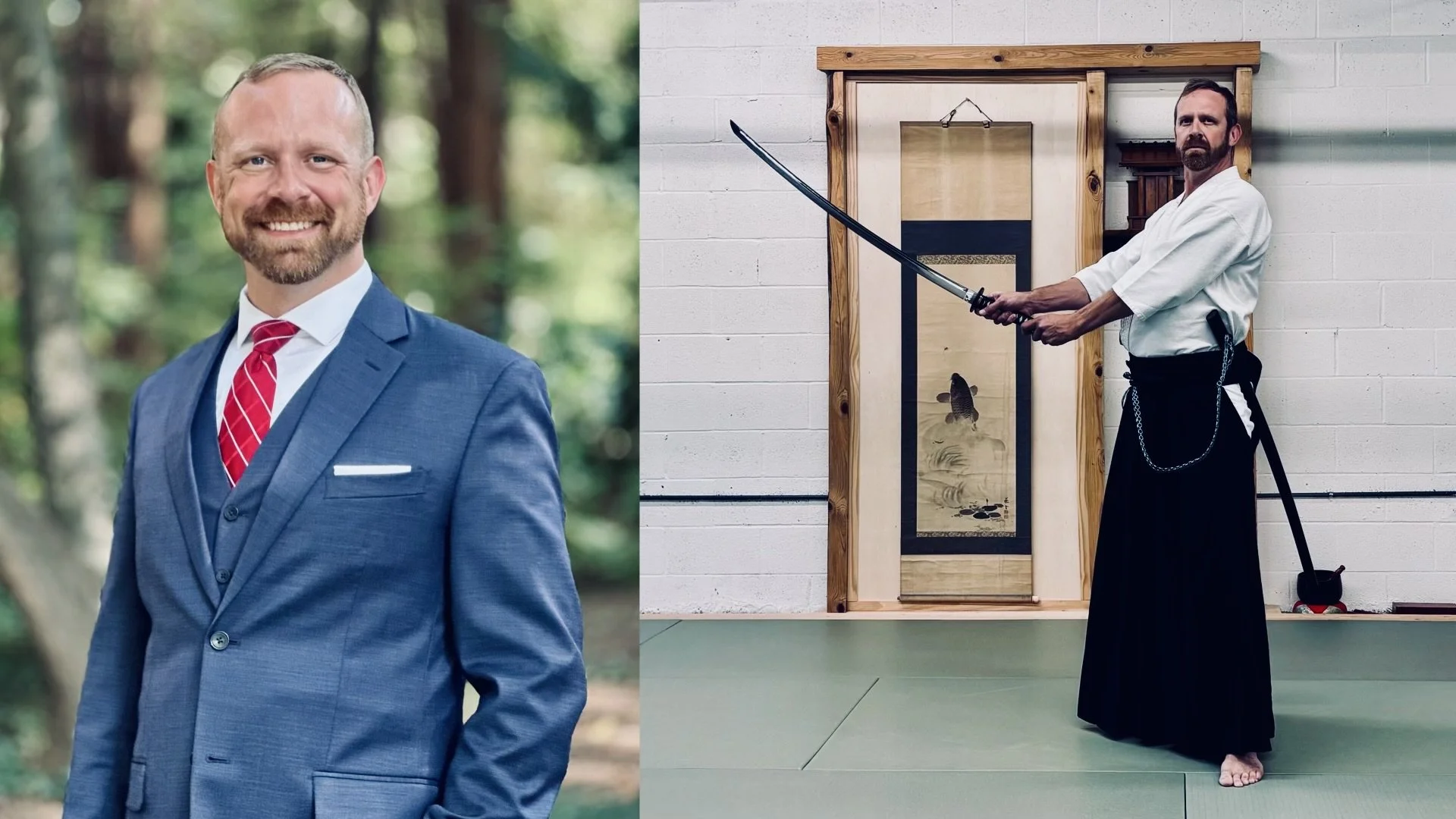
Joshua Karrasch CEO of Dynamic Specialties Group & Deshi of the Ittō Tenshin-ryū
Publisher’s Note: This article is written for a general audience interested in leadership and human performance. While informed by Ittō Tenshin-ryū, Yamate-ryū, and Goseki-ryū Aiki Heihō, it avoids the specialized vernacular of Japanese martial arts to make the ideas more accessible.
Author’s note: Some concepts and phrases in this essay come from teachings Joshua received through Ittō Tenshin-ryū and from his instructor, Joseph Simms. They are shared here as part of Joshua’s lived experience and training, not as ideas he originated.
This article is for the leader who has ever looked back on a decision, conversation, or conflict and realized the problem was not a lack of intelligence. It was that pressure had taken the wheel.
There’s a moment in nearly every person’s life when they begin to realize they are not nearly as in control of themselves as they imagined. For some, it happens in leadership. For others, in conflict, under pressure, in relationships, in failure, or in quiet moments of exhaustion, when effort no longer produces the outcome they expected. The external problem is usually obvious—a struggling business, a fractured team, a life moving too fast—but the deeper problem is harder to confront: the realization that the system may be working exactly as designed, while the person inside it has not yet learned how to work with it.
Like a bull in a china shop, the issue is not just force; it is being unaware of the ramifications of one’s own movement.
And when that happens, many people do what they’ve always done. They react impulsively. They push harder, move faster, and try to overpower friction through effort alone.
Joshua knows that cycle well, because before he ever understood timing, awareness, or discipline, he was struggling with the same questions most leaders eventually face. How do you become someone who is no longer driven by chaos, impulse, and reaction, and instead become what Joseph Simms describes as an “orderly, unfettered human being” capable of doing something meaningful under pressure?
In Joshua’s experience up to that point, by the time he felt compelled to act, his internal system had often already made the decision for him. And untrained, that can be a recipe for disaster.
The issue was not the reaction itself. Some reactions are trained, ordered, and useful. A medic moving toward an injured person before conscious thought catches up is still reacting, but that reaction has been shaped by training. What caused problems for Joshua was something different: an untrained reaction. Movement without order. Energy without awareness. Impulse without relationship to the actual moment.
Looking back, Joshua believes he misunderstood conflict entirely. He had been treating it as an interruption to life rather than as part of its structure. What he would slowly come to believe, thanks to the teachings of the Ittō Tenshin-ryū (more on that later), is that struggle isn’t an anomaly; it’s the baseline condition of being human—life is conflict not only externally but also internally.
The Cost of Unchecked Momentum
Before there was order, there was disorder—a lot of it. Joshua was the kind of leader people noticed early. Driven, relentless, always doing something, and always building. The kind of person who doesn’t wait for opportunity, because he believes he creates it. At least, that’s how it looked. From the inside, it felt very different.
The bull in the China shop really described who I was. A lot of energy, but no direction, like what the Ittō Tenshin-ryū describes as “a raging river without banks,” just flowing wherever the energy carried it. I was driven, hardworking, and trying to get somewhere, but I wasn’t orderly, and I wasn’t in conscious control. I built something people loved—a real community—but I couldn’t manage myself. And you can’t separate those things. If you’re off in one area, it shows up everywhere.
The business, The Gun Dude (at the time), wasn’t failing due to laziness or a lack of effort. It was failing because effort was being applied without structure. Joshua did not yet understand the mechanics of business: margins, inventory cycles, cash flow, and the financial rhythm that keeps a company alive. The system wasn’t intentionally designed; Joshua just endured.
I was always just trying to make enough to pay payroll. I never lifted my head. I didn’t even know how to ask what was making us money. I thought you just sold stuff, paid bills, and whatever was left was profit. I hadn’t broken it down enough to understand how to make it sustainable.
And like many leaders in that phase, Joshua doubled down on the only tool he trusted: more effort. But according to Joshua, effort doesn’t fix disorder; it amplifies it. And what makes this phase more interesting—and more human—is that it wasn’t just the business unraveling; it was his entire life.
The rest of my life was just as chaotic. No banks, no barriers. Whatever had my attention, that’s where my energy went. External chaos is often a reflection of internal state. How you do one thing is how you do all things.
That realization doesn’t feel philosophical when you’re living it. For Joshua, it felt like a problem he couldn’t quite solve. And according to Joshua, the first step toward addressing those challenges was to recognize and acknowledge the chaos.
So the question Joshua faced was whether he could learn to meet that conflict consciously or would simply continue reacting to it unconsciously. Fortunately, right in the midst of that instability, something else was forming.
The Mentor You Don’t Go Looking For
Somewhere in the middle of all of this, Joshua met Joseph Simms - Mr. Simms, as Joshua still calls him. Not through a formal introduction, not through a program, just honestly, through proximity. A coffee shop at Joshua’s store, a conversation, and a presence that just felt different.
He had a presence about him. He stood out, even though he was subtle. He just came in, sat down, and waited. And when we started talking, it felt like meeting an old friend. The relationship just grew. Over time, it became something more.
There was something in the way Mr. Simms carried himself that Joshua recognized before he could name it. He saw something he wanted, and eventually became willing to do the work required to pursue it.
What makes this part of the story important isn’t the moment; it’s what followed, because there was no direct instruction at the time. There were no lessons, no frameworks, and no “do this instead.” The actual key to the mentorship, according to Joshua, was exposure.
Mentorship isn’t ‘tell me what to do.’ It’s exposure. You become like what you’re around. If you spend enough time with someone who operates a certain way, you start to adopt it—how they think, how they move, how they respond.
That idea would later define everything in Joshua’s life, because he would come to believe that leadership, at its core, isn’t learned through instruction; it’s absorbed through proximity and lived experience.
The Path Finds You
Joshua didn’t go from chaos to discipline overnight. In fact, there was a middle phase, one that’s easy to skip over in hindsight. He had been around martial practitioners during his military years before committing to training at the dojo, yet something felt different this time. He saw how people who studied the Ittō Tenshin-ryū carried themselves: the formality, the discipline, and the difference in how they moved and interacted.
What the dojo taught me comes from the life’s work of many individuals, and I don’t want to claim I found something new. I received something, practiced it, and began to understand what it changed in me.
Joshua didn’t fully understand it at that point, but he noticed it. And over time, that observation turned into curiosity. Then necessity. Because when everything else collapsed, he didn’t need another system; he needed a different way of operating.
The Dojo Becomes the Forge
The dojo wasn’t what he expected. It wasn’t an escape, and it wasn’t a hobby. It was a proving ground.
The dojo isn’t a place to hang out. It’s serious. There are expectations. You show up, and you do the work. The kendōkan of the Ittō Tenshin-ryū became a vehicle through which I could explore and realize the principles of the tradition for myself. It’s also a place where I can’t hide. Who I really am shows up immediately.
What showed up at first wasn’t even close to true growth; it was the same pattern—speed, force, and impulse —only now they were visible. And more than that, it wasn’t a clean transition for Joshua. The same reactions surfaced again and again; they were just easier to see each time.
As Joshua came to understand it through the tradition, the ryū preserves methods developed through centuries of observing the human condition under conflict. The principles were not invented so much as recognized, named, and transmitted through training.
In retrospect, Joshua believes that’s what training actually is: not immediate improvement, but repeated exposure to people and philosophies that help an individual understand what isn’t working.
The Teachings of Ittō Tenshin-ryū
As Joseph Simms noted, the primary aim of the Ittō Tenshin-ryū is “the realization of an orderly, unfettered, and powerful being - and then to do something meaningful with that capacity.”
What Joshua eventually learned through the teachings of the Ittō Tenshin-ryū wasn’t simply martial technique. It was a completely different way of understanding pressure, attention, and human behavior. The teachings emphasize timing, distance, posture, awareness, discipline, perception, and, perhaps most importantly for Joshua, how one comports oneself under pressure, not just in combat, but in everyday life.
Embedded within those teachings is a simple but uncomfortable idea: conflict is not occasional; it’s a constant. From relationships to leadership to internal struggle, human life continuously demands resolution under pressure. The goal isn’t to eliminate conflict, but to learn how to navigate it without becoming consumed by it.
What stood out to Joshua was that the system wasn’t built around force. It was built around seeing what was happening clearly enough to stop adding force where force was not needed. The goal wasn’t to react faster, but to perceive more accurately and act more precisely.
On the mat, that lesson showed up physically before Joshua understood it intellectually. In the beginning, when a technique failed, his instinct was to add more force. Push harder. Move faster. Apply more energy. But the more force he added, the less effective the movement became. The correction was often not to do more, but to see more clearly: adjust distance, correct posture, wait a fraction longer, reduce unnecessary tension. When the movement finally worked, it did not feel stronger. It felt cleaner.
That was the lesson Joshua carried forward. More energy did not necessarily create a better outcome. Sometimes it only revealed that he had not yet understood the moment.
For most people, realization comes slowly. For a few, it arrives all at once. Either way, the uncomfortable realization is the same: you are not as in control as you imagined.
I thought I was consciously directing myself. Then I realized I wasn’t in control. I was reacting. My nervous system was making decisions before I was even aware of them. And that changes everything, because if my reactions are chaotic, then my leadership is chaotic too.
That challenged nearly everything about how he had operated as a leader to that point. Until then, most decisions were driven by disorder and chaos: more effort, faster action, more pressure. But his lessons from the Ittō Tenshin-ryū taught Joshua that conflict is fundamental to existence, and that he had to learn to address conflict while living with the ramifications of his actions.
The human body is a system. It has inputs, outputs, and voluntary and involuntary responses. I’m learning how that system works and learning to work with it. That’s all this is. It’s not mystical.
According to Joshua, once you see that, you can’t unsee it. While the teachings may have names and forms that sound mystical to modern readers, their roots are practical and grounded in an understanding of how the human system behaves under pressure. For Joshua, that became the bridge not just into martial training, but into a completely different understanding of leadership and life itself.
The Moment That Changed Everything
The breakthrough didn’t happen in the dojo. In fact, it happened in real life. It was a workplace disagreement that escalated quickly. The kind of moment that usually ends badly, except this time, something different happened.
I could feel myself escalating—going up the ladder very fast. I finally realized it was what the tradition calls the Absolute Critical Moment®, and for the first time, I stopped. Just stopped and walked away for a second. And then came back and thought, why were we even going there? That ability to pause? That’s gold. I left that on the side of the road for years.
What Joshua experienced wasn’t dramatic, but it changed his entire outlook by creating something that hadn’t existed before: choice. What he later learned from the Ittō Tenshin-ryū’s teachings is that conflict isn’t reserved for battlefields, boardrooms, or catastrophic moments.
“From birth to death, life is a battlefield. No matter who you are, where you are from, your profession, financial worth, or social standing, until you learn through direct experience to resolve conflict, there is no peace.” —Joseph T. Simms, The Way and The Power
Joshua came to understand that it was not a call to aggression, but a recognition that conflict is woven into existence. Until a person learns, through direct experience, how to meet conflict internally, peace remains temporary at best.
Alignment Under Pressure
Joshua began to see that many of his own leadership failures had less to do with intelligence, strategy, or effort and more to do with disorder under pressure. He acted too quickly, too emotionally, too forcefully, or from a place he did not yet fully understand in himself.
That realization fundamentally changed how he understood leadership, conflict, and action itself.
When I feel pressed to act immediately, that’s usually the signal that I need to pause. Hesitation when I don’t want to act—that’s avoidance. But sometimes I don’t need to respond at all. There’s no fight if there’s not a second word. And when it is time to act, it feels different. It feels like falling into it—there’s almost a kind of joy in it. Timing is when to act. Distance is how close I am to the problem. Intention is why I’m acting. Focus is what I’m paying attention to. Most mistakes come when those four things are not aligned with the moment.
What Joshua learned through the teachings of the Ittō Tenshin-ryū is that conflict is often shaped long before the visible collision. Posture, emotional state, perception, tension, attention, and intent all influence what becomes possible. The visible outcome is often shaped by invisible conditions already in motion.
That principle applied just as much to leadership as it did to martial training: pressure narrows the range of responses available to a person, urgency collapses distance, and motion can distort intention. And once that happens, even intelligent people begin making poor decisions while believing they are acting rationally.
The teachings of the Ittō Tenshin-ryū challenged that entire pattern. The emphasis wasn’t on reacting faster or overpowering force with more force. It was on perceiving more accurately so that force could be applied only as necessary and only when appropriate to the moment. Joshua came to understand that excessive force often revealed poor attention to the moment itself. The clearer the understanding, the less force required to resolve conflict effectively.
Even posture took on a different meaning. In the dojo, posture wasn’t merely physical positioning; it reflected awareness, composure, emotional state, and intent. Over time, Joshua began recognizing that leadership worked the same way. Teams often reacted less to words than to the condition of the person delivering them. If a leader entered a room scattered, urgent, or reactive, the environment absorbed it immediately.
That became one of the most important leadership lessons Joshua carried forward.
Energy is always moving through the team. If I’m scattered, the team becomes scattered. If I’m urgent, the team becomes urgent. The internal state radiates outward. The more people pick up on that, the more the whole system shifts.
Joshua thinks the “operator” variable is what many organizations overlook. Scaling systems, processes, and strategies can be useful, but sometimes what needs to mature first is the leader’s internal state: attention, reaction, and relationship to pressure.
And no system, no matter how sophisticated, can fully compensate for a leader who hasn’t learned how to govern themselves under pressure.
The Operator Matters More Than the System
It’s easier to upgrade tools than to upgrade behavior, and Joshua believes that’s one reason so many leaders instinctively look outward when problems arise: new software, new processes, new frameworks, and new organizational structures. Most systems get built with the assumption that better mechanics will eventually compensate for poor execution.
But according to Joshua, systems rarely fail on their own. More often, they fail because the person operating them brings confusion, urgency, ego, distraction, or unresolved pressure into the environment itself.
It’s easier to change a tool than to change how I respond under pressure. But a good system in the hands of an unregulated operator still produces poor results. A strong operator can work with a weak system and still get good results.
That distinction became impossible for Joshua to ignore once he began training seriously. In the dojo, no amount of equipment, theory, or external structure could compensate for poor awareness, emotional instability, or lack of composure under pressure. Eventually, he realized leadership worked the same way.
A reactive leader can turn even healthy systems into chaotic environments. A grounded leader can stabilize imperfect ones long enough for meaningful improvement to happen.
That’s why Joshua thinks leadership ultimately lives upstream of the actual systems. Before strategy, communication, and execution, there is the operator—the human being who interprets pressure, makes decisions, regulates emotion, assigns meaning, and shapes the environment everyone else must operate within.
And that, according to Joshua, is the harder work, because upgrading a system is technical while upgrading the operator is personal.
The Only Lever That Matters
After the failure, the relationships, the mentorship, the training, and years spent learning where reaction ends and awareness begins, Joshua’s conclusion no longer feels complicated to him.
Not easy, but surprisingly simple in concept.
What I learned at the dojo, in the most cathartic form, came from the Ittō Tenshin-ryū, which taught me—and I quote—“the only thing in this life that one has a modicum of control over is how one comports themselves.” That’s it. Not outcomes. Not other people. Just how we respond. And that determines everything else.
For Joshua, that idea eventually became much larger than leadership. The teachings of the Ittō Tenshin-ryū treat conflict as a permanent condition of life. The goal was never to escape the pressure, but to find clarity within it. Not avoidance or domination, but rather alignment.
Over time, Joshua came to understand that conflict rarely gets resolved through force alone. More often, it’s shaped by the condition of the person entering it. The better a person understands themselves within the moment, the less unnecessary force they bring into it—and the more precisely they can act if or when action is required.
And that’s why the training never really ends, because pressure never disappears. According to Joshua, the real work is not becoming fearless, flawless, or perfectly composed. It’s becoming someone who can recognize the moment before reaction takes over. Someone who is aware and able to act with clarity in the moment.
So when the pressure builds—and it will—when everything in you wants to move immediately, the question is no longer: What should I do? It becomes: Am I life-forged enough to be aware in the moment and act with clarity?