Hanasu - To Let Go
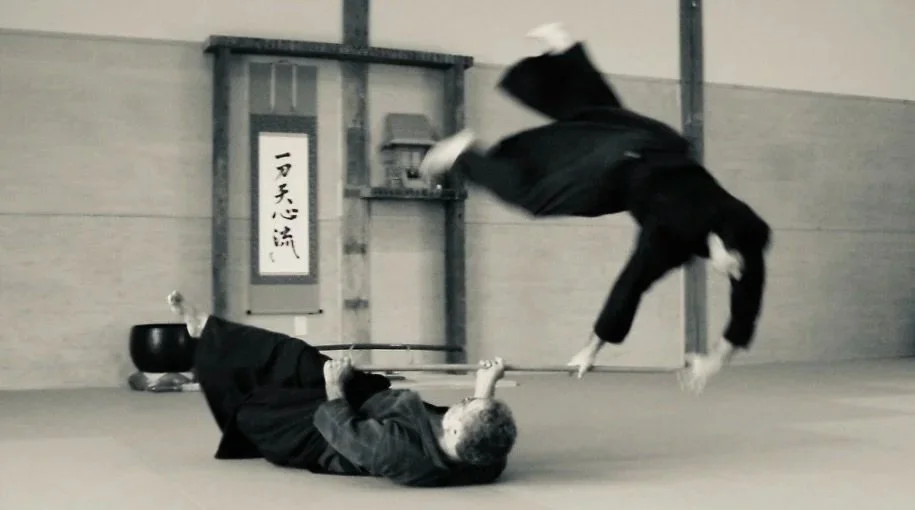
“Hanashi no heiho does not mean that you should try something new simply because it is new; it means you should not stick to something oldjust because it is familiar. It is this fine line, the division between effective and familiar, which requires careful attention.” — The Way and The Power
On the first weekend of May in 2026, the deshi of the Yamate-ryū gathered in Chicago as the guests of Mr. Ritacco and Dr. Musicar for an intense weekend of discovery and experimentation with hanasu. Mr. Simms later informed me that this Taikai was more difficult to prepare than most. It has taken me weeks of reflection to digest the lessons and synthesize this retrospective. For a simple concept, this was a tough one.
We began the weekend with a physical exploration of what it means to “let go”. Letting go, we discovered, requires one to Hold On. Holding on can manifest as pulling something closer (attachment) or pushing it away (aversion). Both require attention, and that attention leads to a self-reinforcing loop that tightens the grip.
So we began with a grip. A tight grip, where the problem has already taken hold. A grip that you can’t push or pull your way out of. Pay attention to the grip and you are immobilized, look away and you are free. We felt this strong, dedicated tsukami-te with a hint of yonkyo pinning our arm. “Find someone bigger than you, and get them to grab you hard,” was the instruction. No matter what you do when gripped like this you hit a wall. You try something and it fails.
This recognition is the first condition for hanasu. This ability to observe, and recognize the moment a barrier arises. We are trained from childhood to seek success and avoid failure, but Mr. Simms demanded that, this weekend, failure was success. We looked for the moment when the plan falls apart, and you get stuck wondering “now what?” Recognition of that moment, it turns out, is the key to moving past it.
The second condition for hanasu is vocabulary. After the barrier is observed, you need a toolkit, a vocabulary, to find your way beyond the barrier. For this Taikai ikkyo was our starting point. Mr. Simms and Mr. Stevenson taught multiple distinct soden from ikkyo, each a response to uke’s input. These soden alone were worth the price of admission. Every time uke pushed up, pulled left, or stepped out, we learned another soden that kept uke off balance all the way to the tatami. We did not force the familiar, but instead sought out the effective.
These two conditions, an ability to observe a situation without bias and a vocabulary of skills to draw upon when you do, typically require years of keiko. Yet, by the end of the weekend even mudansha were demonstrating a basic understanding.
Hanasu - such a simple idea. If something stops working, do another thing. And yet every one of us gets trapped in our routine, fooled by our success, stuck in our deeply rooted understanding of how the world works. Hanasu demands we release our grip on the familiar, and look beyond the grip the familiar has on us.
Mr. Simms said this Taikai was difficult to prepare. I understand the difficulty now. Hanasu is not something that can be taught. Instead, he arranged a series of moments in which each of us could catch ourselves in the act of holding on, and then, sometimes, let go.