

A Mind Like A Stone
Republished from Budō Shinbun, 1993
By Savvas Savopoulos
The tale of a kangeiko...
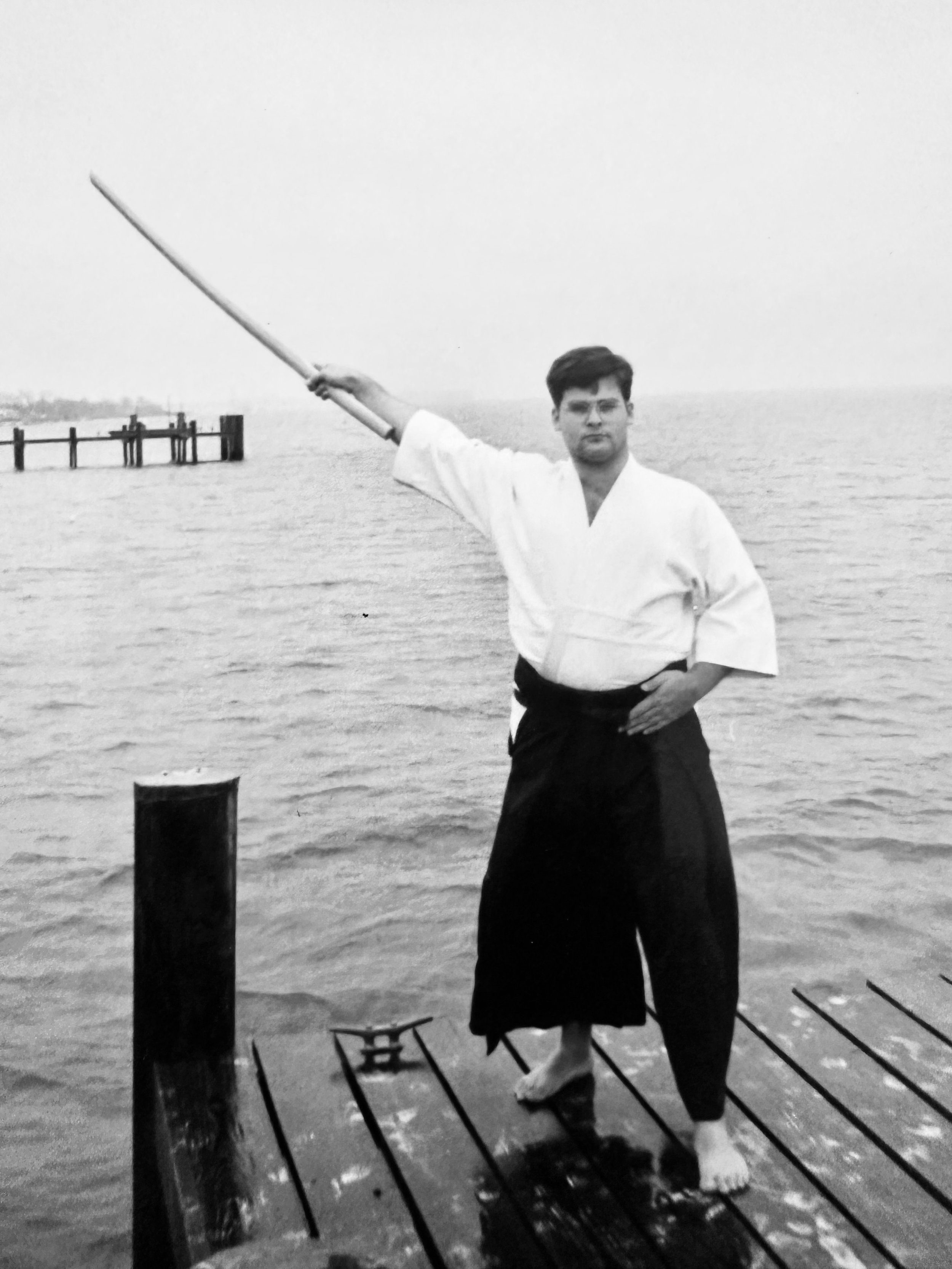
Savopoulos Sensei stands in Ten no Kamae on the ice-covered dock, preparing to enter the frigid waters of the Chesapeake Bay.
My sensei, Mr. Adam Schutz, arrived on Kent Island, Maryland, which is in the middle of the Chesapeake Bay, at 11:30 a.m., to meet me for winter training at my parents house. I had (stupidly) made a joke, in passing, on the previous Sunday, about what a nice place it would be for winter training. Of course, Mr. Schutz accepted any implied invitation to conduct a severe training session.
We suited up and went out the back door and onto the dock, where we were 120 feet from shore and over freezing water. The sleet was falling on the wood, making a slippery covering of ice but, surprisingly, we did not even notice the temperature, although we had left our zori inside the house.
Mr. Schutz, believing that he must not ask his student to do what he has not already done, did Sanchin, ran the length of the pier in jodan, and hurled himself off the end and into the 6' deep water. No hesitation. No concern. No life preserver. No safety rope. Sensei had chosen to go to war with nature, and had taken me with him.
The temperature was so extreme that Mr. Schutz told me, a person whom he had subjected to many traumas, that I did not have to go into the water. I went to the end of the dock anyway, did Sanchin, poorly, and likewise hurled myself into the water. As I surfaced, Sensei ordered me to breathe Sanchin. I got my feet under me, and walked towards the shore, first in chudan, then jodan, then doing nissoku as I gained more and more control over breath and body.
The water was the hardest, most all-encompassing, thing that either of us had ever been hit with. It grasped us so intensely, all at once, all over, that our minds became totally blank. Yet we did not let go of our swords.
The water was beyond anything we have ever felt. It was beyond bitterly cold. So cold it was spirit seizing. So intensely cold that it was not like cold or even like a liquid; it was solid, like being wrapped in amber. So cold as to fight with us for control, and we won.
We had to fight in a very hostile arena. When the freezing cold tried to crush our body's physical abilities, we fought back with kokyu-chikara until our bodies were freed and we were once again in control of all of our weapons. Body, breath and spirit were one.
With each breath that flowed into the hara, the battle shifted until we were no longer frozen by the icy fist of the sea. We could breath, so we could move. We could swim, so we could win. As there was no way straight up to the dock, we had to fight our way to the shore or die. This taste of ultimate reality...this taste of death, is unique. And we conquered.
The water temperature was 31 degrees. When exiting the water the temperature grew comfortable and, even though the rocks were slicing into our feet, we paused to do Sanchin. The world was calm, yet violent, and it was beautiful.
Once we were both on the shore, completely soaked and with steam rising off of us, we faced each other, performed ritsurei, and did one execution of kotegiri each. It was effortless, smooth, and exquisitely intense. The kiri-oroshi stopped right on the skin from the full-power cut, and the kiai thundered over the bay. The dock was too small. The bay was too small. Even the world felt too small. We were in each others way. The world was in our way. We felt totally relaxed, yet there was only now. We felt violent and graceful.
Why is this not like walking into the water? Why is this not like training in the snow? Why is this not like skydiving? This is why:
When walking into the surf, you can always turn back: you have set a mental limit on how far you will and can go. Jumping into ice-water your body goes into shock. Walking in, you always, in the back of your mind, know that you can escape.
When you train in the snow, only the part of your body that you feel comfortable exposing to the elements makes direct contact with the snow. Further, snow has insulating properties that reduce the feeling of cold. Water renews its wave of coldness with every movement and moment of contact. Additionally, when you train in the snow, you know that you can just turn around and walk back inside. When jumping off a pier, 120 feet from shore, into water that is far out of reach of the pier, you have no idea of whether or not you can survive. All you know is that you cannot go back. You cannot go back up onto the dock, as there are no stairs or ropes. Until you leap off the edge, you can go back. Once you leave the dock, you are committed. You must go in and risk death at the hands of an unknown enemy.
With skydiving, the issue is simple. Most would not jump without a parachute. Safety features lull you into complacency. Besides your own spirit, there is no way to survive in the freezing water.
Over ten days after experiencing this battle, we are still on. The typical worries of daily life are insignificant. We are focused on what is important: budō.
Note: I try to stay away from all meats except for fish and, occasionally, chicken. Mr. Schutz loves seafood, so we had planned to go to one of the local marinas to sample the delicacies of the bay. After training, however, our bodies rejected the idea. Instead, they forced us to go to the local barbecue joint and get slabs of beef ribs. We had trained close to the edge, and our animal, carniverous, instincts surfaced.
The End